The bed used to be sacred. Now it’s a command center.📱🛏️
Bedroom for restorative sleep
There was a time when the bed was sacred. A place for rest, dreams, whispers, and stillness. But somewhere between the first notification and the last doomscroll, the bed became a desk. It happened slowly—one ping at a time.
If you’re like most people, your phone doesn’t just sleep next to you—it sleeps with you. It’s your alarm clock, your flashlight, your news feed, your late-night companion, your morning meeting reminder. The device that was supposed to make life easier has blurred the line between work, social life, and sleep. And the human brain? It’s paying the price.
⏳ The Midnight Shift No One Signed Up For
Let’s zoom out. For centuries, nighttime meant withdrawal from the world. Firelight, candlelight, whispers. By the 20th century, electric bulbs stretched the evening. Then came television, carving out late-night hours. But nothing has been as invasive, personal, and persistent as the smartphone.
Unlike the TV or lamp, your phone doesn’t stay in the living room. It follows you under the covers, glowing at the edge of your vision, vibrating against your skin. It doesn’t respect boundaries because, in many cases, we erased those boundaries ourselves.
In less than two decades, we turned the bedroom—a space once anchored to stillness—into a 24-hour command center. Email. Texts. Work messages. Social media. News alerts. Online shopping. Dating apps. Games. Bank notifications. All of it… right there, where we’re supposed to surrender to sleep.
🧠 Your Brain Thinks Your Bed Is a Meeting Room Now
Phone glow in a dark bedroom
Here’s the thing: your brain is always learning cues from your environment. In sleep science, this is called stimulus control. When your bed is only associated with sleep (and maybe intimacy), your brain responds quickly: you lie down, it knows what to do.
But when the bed is also where you answer emails, read breaking news, scroll through Instagram reels, and binge late-night TikTok… the brain learns something else entirely: “This is a place where things happen.”
That alert, buzzing, information-processing mode is the opposite of the quiet, low-arousal state your brain needs to slide into sleep. Instead of winding down, your nervous system stays on watch.
💡 The Alert That Bursts Your REM
Even if you do fall asleep, your phone still knows how to find you.
One stray notification during your REM cycle—your brain’s most delicate dream stage—can trigger a micro-awakening. You may not fully remember it, but your body does. Heart rate spikes. Breathing quickens. The restorative rhythm fractures.
Worse still, anticipation can be just as powerful as interruption. If you’re expecting a text from someone, or your work Slack is still logged in, your brain sleeps lighter. Like a guard on night shift. Always listening for the buzz.
Studies have shown that even the mere presence of your phone on the nightstand can raise nighttime vigilance. A glow, a buzz, a phantom vibration—it’s all it takes.
💤 The Great Boundary Collapse
The Industrial Revolution taught humans to extend the day with light. Smartphones taught us to erase it entirely.
The day doesn’t end anymore—it just blends. Work conversations spill into 11:47 p.m. Social media wars sneak in at 2:12 a.m. And news alerts don’t care that your alarm is set for 6:30.
Our ancestors once segmented the night into quiet, ritualized rhythms: prayer, reflection, slow drift. Now, we segment it into microbursts of dopamine. A like here. A comment there. One last scroll.
This isn’t weakness—it’s design. Smartphones are engineered to hook attention. Infinite scroll, auto-play, push alerts—they all thrive in the bedtime gray zone, when your willpower is tired and your brain is craving one more hit of stimulation.
🔊 How Sound Can Take Back the Night
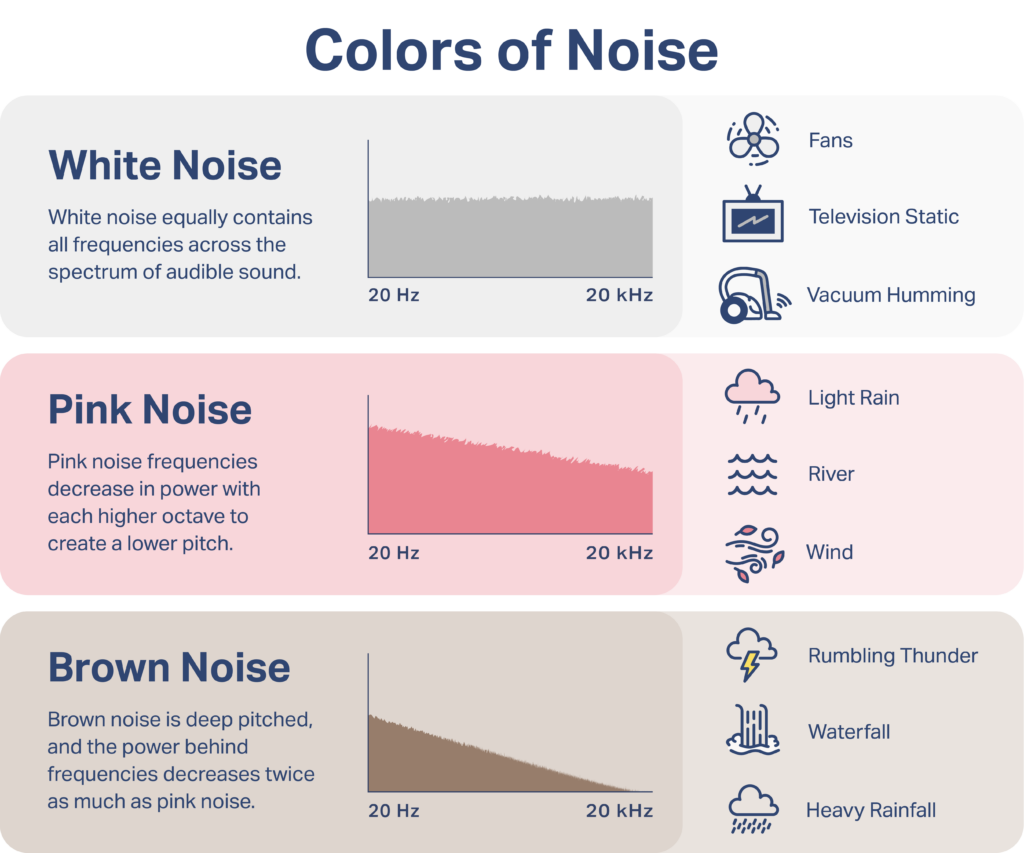
The sound rainbow with three colored sections.
Here’s the hopeful twist: just as we built this problem, we can unbuild it.
One of the most powerful cues for sleep is predictable sensory input—especially sound. Before the age of devices, many people drifted off to steady night sounds: crickets, wind, hearth crackles, distant rain. These signaled safety and consistency to the brain, allowing it to let go.
Today, sleep apps use this same principle with soundscapes—pink noise, brown noise, ocean waves, gentle hums—that mask unpredictable spikes (like that text you shouldn’t have checked) and build a stable sound “cocoon” around your sleep.
The idea isn’t to add more noise to your life. It’s to replace chaotic inputs with rhythmic, boring ones. The kind that tell your nervous system: we’re safe, nothing’s happening, go ahead and drift.
A few simple, science-backed moves:
Park your phone outside the bedroom (or at least across the room).
Wind down with non-stimulating sound, like pink noise or a low-level fan hum, instead of endless notifications.
Make the bed sacred again—train your brain to associate it with rest, not scrolling.
Schedule the cutoff: a digital sundown an hour before bed. (Churchill had naps. You get silence.)
🛏️ From Command Center Back to Sanctuary
The bed wasn’t meant to be a war room. Or a desk. Or a doomscrolling pit. It was meant to be a retreat—a soft, dark cave where the brain lowers its guard, where sleep unfolds without alerts, without urgency.
Our ancestors once used canopies, shutters, and rhythmic rituals to keep the night out. We have pink noise, “Do Not Disturb,” and the radical option of putting the phone down.
The choice isn’t about giving up tech. It’s about reclaiming boundaries.
👉 Be honest—how often do you check your phone in bed? 😅 What’s your personal boundary (or the one you wish you had)? And what sound—rain, pink noise, silence, fan—could replace that last scroll?
#SleepScience #DigitalDetox #MindfulRest #SleepSmart #PinkNoise #SleepRitual #NoQuickFix #CircadianRhythm #SleepHealth